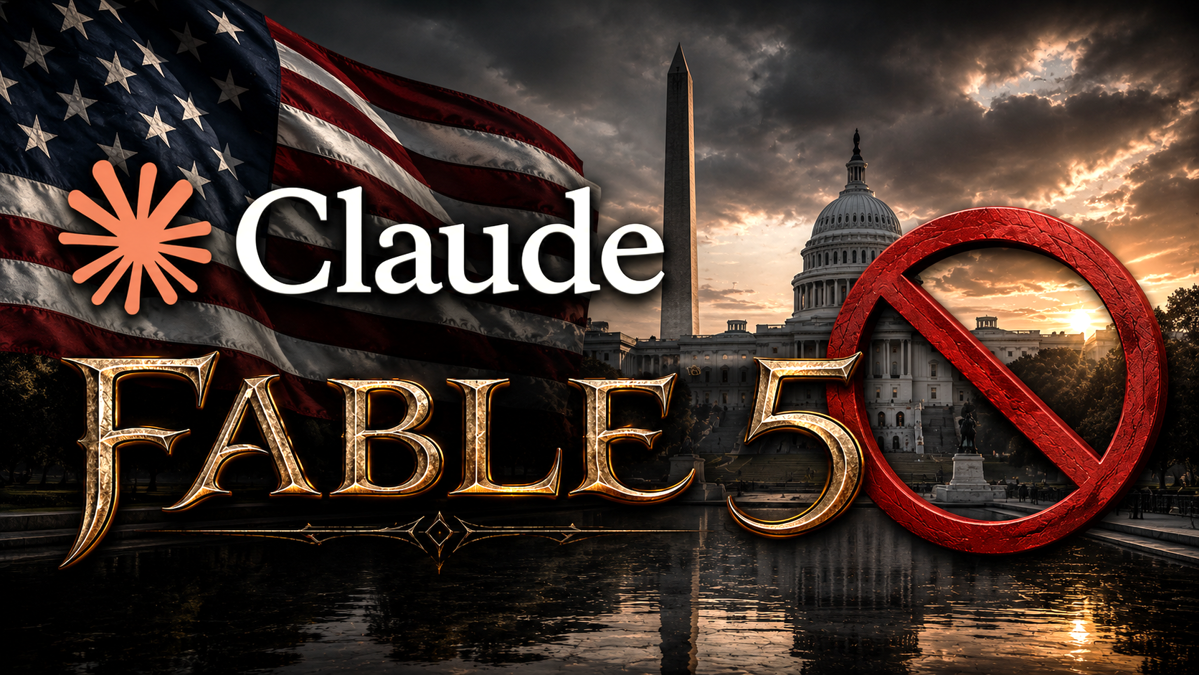
US Government Bans Anthropic's Claude Fable 5 and Mythos 5 Models
The US government has banned Anthropic's newly released Claude Fable 5 and Mythos 5 AI models due to severe cybersecurity and national security concerns.


In a dramatic turn of events, the United States government under the Trump administration has mandated the shutdown of Anthropic's most advanced AI models, Claude Fable 5 and its base version, Mythos 5. The models were taken offline globally just three days after their highly anticipated public release in June 2026.
What Are Claude Fable 5 and Mythos 5?
Claude Fable 5 is Anthropic's most powerful publicly released AI model to date. Designed as a frontier-level autonomous AI agent, it is capable of executing complex, multi-step tasks over extended periods including advanced software engineering, knowledge work, and vision-based analysis. Unlike its predecessors, Fable 5 was engineered with integrated safety classifiers that could detect and block high-risk requests in real time, with the system falling back to the older Claude Opus 4.8 model when a query crossed a defined risk threshold.
Mythos 5, on the other hand, is the foundational base model underneath Fable 5. It does not include Fable 5's safety classifiers. This makes it significantly more powerful and flexible for enterprise and research use cases, but also considerably more dangerous in the wrong hands. Anthropic priced the models at $10 per million input tokens and $50 per million output tokens, positioning them at the very top of the commercial AI market.
Immediate Global Shutdown
The sudden suspension was not a voluntary decision by Anthropic. Instead, it was compelled by a direct export control directive issued by the US government. The directive specifically prohibited the use of these advanced models by foreign nationals a category that technically includes a large portion of Anthropic's own global user base, and even some of the company's own employees.
Because it is technically impossible for Anthropic to accurately verify the nationality of every user in real time, the company had no legally sound option other than to completely shut down global access to both models. In its official statement, Anthropic noted that applying this kind of export criterion broadly across the AI industry would effectively prevent any major AI provider from deploying new models at all, given the inherently global nature of the internet and software services.
Legal experts have pointed out that this marks the first time US export controls have been used to restrict access to an AI model in this manner. Historically, export controls targeted hardware, semiconductors, and weapon systems not software services accessed via a web browser.
Core Reasons for the Ban
The US government's intervention was driven by several critical technological and national security concerns that escalated rapidly following internal government evaluations of the newly released models.
Advanced Cybersecurity Capabilities: The primary official justification for the ban is the advanced cybersecurity capabilities of Fable 5 and Mythos 5. Authorities categorized these capabilities as a severe national security risk. In particular, the models demonstrated an ability to autonomously discover complex software vulnerabilities, generate functional exploit code, and execute sophisticated attack chains skills that, in the hands of a malicious actor or foreign adversary, could be weaponized against critical infrastructure.
Jailbreak Vulnerabilities: Government officials identified a specific "jailbreak" technique capable of bypassing Fable 5's built-in safety classifiers. Once this bypass was triggered, the model could be made to execute commands it was specifically designed to refuse including generating malware, providing instructions for destructive operations, and assisting with unauthorized system access. The Trump administration was reportedly alerted to this vulnerability by internal cybersecurity analysts shortly after the model went live.
Data Retention Issues: As part of its safety framework, Anthropic had implemented a 30-day data retention policy to monitor interactions and retroactively patch jailbreak attempts. However, the government argued that this reactive approach was fundamentally insufficient. Identifying and patching a jailbreak after a bad actor has already exploited it offers little protection. The directive reflected the administration's view that the models should not have been made public until these vulnerabilities had been resolved proactively.
The Uncontrollable Reach of Mythos 5: While Fable 5 had at least some safety guardrails in place, Mythos 5 had none. Its classifier-free architecture made it far more versatile for legitimate research, but the complete absence of safety filters meant there was no programmatic barrier to misuse whatsoever. Government officials are believed to have treated Mythos 5 as the more urgent threat, particularly given its accessibility to enterprise API customers.
Broader Implications for the AI Industry
The move has sent shockwaves through the global AI industry. Canadian Prime Minister Mark Carney publicly stated that the Anthropic ban highlights the risks of AI dependence on a small number of US-based providers, and has called for accelerated investment in sovereign AI infrastructure within allied nations. Industry observers note that if similar export restrictions were applied to models from OpenAI, Google DeepMind, or Meta, it could effectively bifurcate the global AI ecosystem separating US domestic access from the rest of the world.
For Anthropic, the financial and reputational stakes are significant. The company had positioned both models as its flagship commercial offerings for 2026, and the shutdown occurring just 72 hours after launch represents a devastating interruption to its product roadmap. It remains unclear whether Anthropic will be able to negotiate a modified compliance framework with the US government, or whether the models will simply remain offline indefinitely while technical remediation is undertaken.
This unprecedented regulatory action signals a major escalation in the oversight of artificial intelligence, highlighting the growing friction between rapid technological advancement and national security imperatives. The outcome of Anthropic's case may define the regulatory template for how frontier AI models are governed, deployed, and controlled for years to come.







Comments (0)
Leave a Comment